How I Built an AI Assistant and a System Where Nothing Gets Lost
Managing multiple products simultaneously means one thing: information chaos. Between Slack notifications, meeting notes, action items, and client updates, something always slips through the cracks. After watching too many important tasks get buried in thread noise and spending my mornings playing catch-up, I decided to build something different.
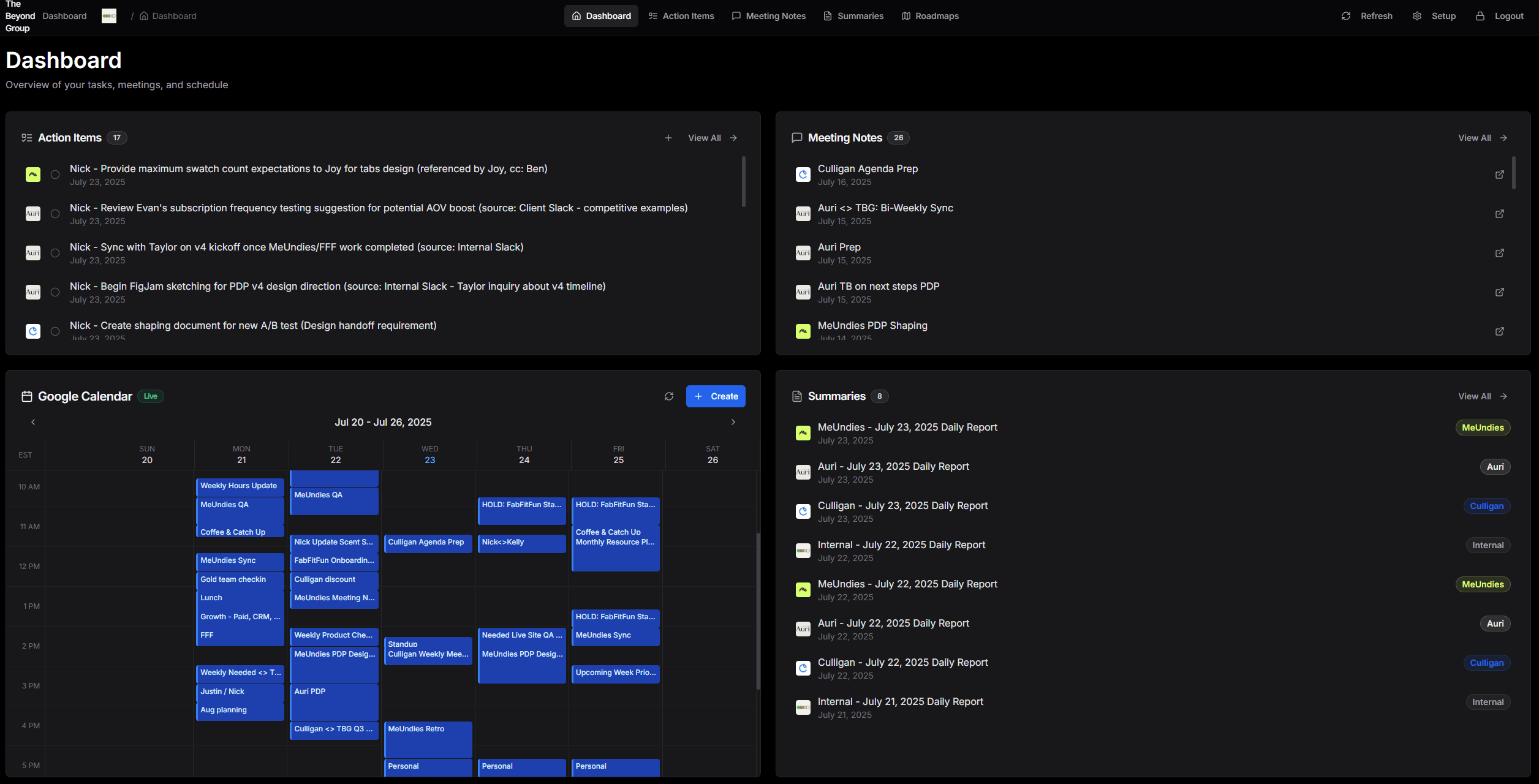
The result? A real-time dashboard system that eliminated 10+ hours of weekly manual reporting and created a fail-safe where literally nothing gets lost.
The Problem Every Multi-Product PM Faces
When you're juggling Auri's nutraceutical growth strategy, Culligan's DTC expansion, and MeUndies' post-migration optimization, your day becomes an endless cycle of:
- Checking 12+ Slack channels for updates
- Parsing through meeting notes for action items
- Manually compiling daily summaries
- Context switching between roadmaps, calendars, and project tools
- Playing detective to figure out what happened yesterday
The cognitive load is crushing. More importantly, things get missed. That client concern mentioned in passing during a standup. The action item buried in a 47-message Slack thread. The roadmap update that didn't get communicated to the right stakeholders.
Building the Solution: Zapier + AI + v0
I built an integrated dashboard system that connects every tool I use through Zapier automations, processes everything through Claude's API, and displays it all in a custom interface built with v0.
Here's what it does automatically:
Meeting Intelligence
Every call I take gets transcribed through Granola and Gemini. The system pulls these transcripts into a centralized hub where I can have AI-powered conversations with the content. Instead of ctrl+f searching through notes, I ask questions like "What concerns did the MeUndies team raise about site speed?" and get contextual answers instantly.
Action Item Failsafe
This was the game-changer. The system parses every Slack message I send or receive across all channels, plus all meeting transcripts, and automatically extracts action items. Everything gets centralized in a database with real-time updates. No more lost tasks, no more "I thought you were handling that" moments.
Proactive Daily Intelligence
Instead of starting my day figuring out where things stand, I get AI-generated summaries delivered to Slack each morning. Product-specific updates that pull from relevant channels plus my last 3 meetings for each client. I know exactly what needs attention before I even open my laptop.
Embedded Everything
The dashboard includes embedded Google Calendar, each client's roadmap (pulled directly from Google Sheets), and real-time data from Shopify, Recharge, and Analytics. No more tab switching. No more "let me pull that up" moments in meetings.
The Technical Architecture
Zapier orchestrates everything through targeted API calls:
- Slack API captures all communication in real-time
- Meeting platforms feed transcripts to the system
- Claude API processes raw data into actionable intelligence
- v0 creates the dashboard interface that brings it all together
- Google APIs embed calendars and roadmaps seamlessly
- Ecommerce platform APIs pull client performance data
The beauty is in the automation. I built it once, and it runs continuously without intervention.
Real Business Impact
The numbers tell the story:
- 10+ hours weekly saved on manual reporting and status updates
- Zero missed action items since implementation (previously 2-3 per week)
- 30-minute morning prep replaced 90-minute daily catch-up routine
- Proactive client communication instead of reactive damage control
But the real impact goes beyond time savings. When you're not spending mental energy tracking what needs tracking, you can focus entirely on strategic thinking and client outcomes.
The Broader Lesson
This isn't just about building a dashboard. It's about recognizing that modern product management requires modern solutions. The traditional approach of manually managing information across dozens of tools doesn't scale when you're responsible for multiple products moving at startup speed.
The key insight: your job as a PM isn't to be good at remembering things or manually aggregating data. Your job is to drive product outcomes. Build systems that handle the operational overhead so you can focus on what actually matters.
Key Takeaways
- Automation isn't about replacing human judgment, it's about eliminating human busy work
- AI-powered parsing turns information chaos into structured intelligence
- Real-time dashboards create single sources of truth that prevent miscommunication
- Proactive systems beat reactive workflows every time
- The best PM tools are often the ones you build yourself
If you're drowning in information scatter across multiple products, stop accepting it as normal. The tools exist to build something better. The question isn't whether you have time to build it. The question is whether you have time not to.

Nick Wallace
Senior Product Manager & SaaS Leader